Showing posts with label Nova Scotia. Show all posts

Monday, February 15, 2016

Nova Scotia Heritage Day: The Legacy of Joseph Howe


https://heritageday.novascotia.ca/content/2016-honouree-joseph-howeThis year on Heritage Day, Nova Scotia honours Joseph Howe. Born in 1804 in Halifax, Howe served as a journalist, politician, premier and lieutenant-governor of Nova Scotia before his death in 1873.  Although Howe is perhaps most known across Canada for trying to keep Nova Scotia out of Confederation, he contributed to the creation of many local institutions like the Halifax Public Gardens, and promoted local authors like Thomas Chandler Haliburton in his newspaper, The Novascotian. Howe was a colourful character who could convince almost anybody of his way of thinking: the Canadian Encyclopedia claims that Howe "could use his oratorical powers to influence his compatriots as no other man has ever done."

Today, Howe's most enduring legacy is as a defender of free speech. In 1835, Howe was accused of criminal libel against local magistrates after he accused them of swindling Nova Scotia's citizens out of 30,000 pounds. After spending two days vigorously pleading his own defense he was swiftly acquitted of wrongdoing and thus proclaimed "the press of Nova Scotia is free".  Dictionary of Canadian Biography.

http://discover.halifaxpubliclibraries.ca/?itemid=|library/m/halifax-horizon|1511056John Ralston Saul's Joseph Howe & the Battle for Freedom of Speech is based on a lecture Saul delivered at King's College School of Journalism in Halifax in 2004. Saul suggests that Howe's fight to expose government corruption through his newspaper contributed to a distinctly Canadian position on freedom of speech and freedom of the press that remains at the heart of smart Canadian journalism today. "In a style that is highly articulate, humorous and emphatic, John Ralston Saul provides a succinct, relevant look at Canadian history, our current whereabouts, and an ambitious rally for participatory democracy and intelligent media for the future." Publisher.

For more information on Joseph Howe, visit the Nova Scotia Heritage Day website.
 
For a full listing of our library holdings on Joseph Howe, please click here. Please note that many of these items are rare or delicate and might require visiting our libraries in person to view the material.

In honour of Joseph Howe, here are a few other books about media freedom:

    
http://discover.halifaxpubliclibraries.ca/?itemid=|library/m/halifax-horizon|1858458The new censorship : inside the global battle for media freedom by Joel Simon describes the threats to media freedom happening today across the world. "Journalists are increasingly vulnerable to attack by authoritarian governments, militants, criminals, and terrorists, who all seek to use technology, political pressure, and violence to set the global information agenda. Reporting from Pakistan, Russia, Turkey, Egypt, and Mexico, among other hotspots, Simon finds journalists under threat from all sides. The result is a growing crisis in information―a shortage of the news we need to make sense of our globalized world and fight human rights abuses, manage conflict, and promote accountability." Publisher.

http://discover.halifaxpubliclibraries.ca/?itemid=|library/m/halifax-horizon|1861290    Compared to many of the abuses facing journalists around the world, journalists working in Canada have much more freedom, but that doesn't mean that we can take the freedom of the press for granted. Mark Bourrie's Kill the messengers : Stephen Harper's assault on your right to know is a critical look at the restrictions placed on access to information by the Harper government."The public's right to know has been undermined by a government that effectively killed Statistics Canada, fired hundreds of scientists and statisticians, gutted Library and Archives Canada and turned freedom of information rules into a joke. Drawing evidence from multiple cases and examples, Bourrie demonstrates how budget cuts have been used to suppress the collection of facts that embarrass the government's position or undermine its ideologically based decision-making. Perhaps most importantly, Bourrie gives advice on how to take back your right to be informed and to be heard." Publisher.
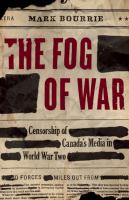
http://discover.halifaxpubliclibraries.ca/?itemid=|library/m/halifax-horizon|1754745Also written by Mark Bourrie, The fog of war : Censorship of Canada's media in World War Two looks at some of the fascinating stories that were censored in Canada due to concerns for our national security and civilian morale. "In Mark Bourrie's illuminating and well-researched account, we learn about the capture of a Nazi spy-turned-double agent, the Japanese-Canadian editor who would one day help develop Canada's medicare system, the curious chiropractor from Saskatchewan who spilled atomic bomb secrets to a roomful of people and the use of censorship to stop balloon bomb attacks from Japan. The Fog of War investigates the realities of media censorship through the experiences of those deputized to act on behalf of the public and reveals why press censorship in wartime Canada was, at best, a hit-and-miss game." Publisher.

http://discover.halifaxpubliclibraries.ca/?itemid=|library/m/halifax-horizon|1583629Many of us acknowledge the necessity for some censorship during wartime in order to maintain public safety, but the terrorist attacks of 9/11 have greatly muddied the waters. Free speech in fearful times : after 9/11 in Canada, the U.S., Australia & Europe is an anthology edited by James L. Turk and Allan Manson that delves into the implications of current anti-terror laws on our freedom of expression. "Free Speech in Fearful Times offers a unique perspective on how the laws created to "protect" us can actually harm us. Following the events of 9/11, rashly conceived anti-terror laws were introduced that put civil liberties at risk, and eliminated long-standing legal protections in Canada, the United States, Australia, Europe, and the United Kingdom. Internationally recognized experts analyze the impacts of anti-terror laws and offer solutions to protect freedom of expression, academic freedom, and civil liberties."


Monday, December 21, 2015

Have Yourself a Merry Local Christmas


Atlantic Canada celebrates the holidays! Here are some local holiday-themed books to enjoy over the Christmas break.

Celebrate!: the history and folklore of holidays in Nova Scotia by Clary Croft

This informative book covers many of Nova Scotia’s evolving religious, patriotic, and folk holidays, which are constantly blending with other cultures and being reinvented, revived, or forgotten. I enjoyed how the author emphasized that there is no “right” way to celebrate holidays because traditions and celebrations are very personal things.

A Maritime Christmas Treasury: stories, songs, and poems to celebrate the season

This anthology includes beautiful pictures to entertain both children and adults. Sweet, humourous stories feature a protective Canadian goose, a special little girl and a dollhouse she desperately desires but cannot afford, and a mouse’s Christmas in Prince Edward Island. Also included is a story about a Nova Scotian girl and her uncle choosing the huge Christmas tree that will be sent to Boston that year as an ongoing show of gratitude for the city’s aid after the Halifax Explosion in 1917. There are also many poems and songs that highlight a different part of the holiday: the food, family memories, presents, and the beauty of the natural world.

Mary Morrison’s Cape Breton Christmas by Bette MacDonald

This very funny book allows the beloved Cape Breton character Mary Morrison to give her sage advice for getting through Christmas: avoiding family, making fruitcake that no one will eat, and always keeping a cocktail handy so you can drink your way through the holiday. Mock recipes end in amusing anecdotes like “I cannot, in good conscience, reveal the remaining ingredients for this recipe” (due to the dangers encountered by those who have eaten it in the past).

Sleigh Tracks in New Snow: Maritime Christmas stories by Wayne Curtis

This collection of Christmas stories features snapshots from the author’s life, from his childhood growing up in rural New Brunswick in the 1950s to visiting the Yukon for three months as an adult. It’s fascinating to read about how life has changed since the 1950s—as the author puts it, a time “when life was more innocent, more romantic, and perhaps not so much commercialized.” But Curtis’ stories also reveal how life then was filled with more danger and uncertainty as well, without many of the social programs that support people when they are ill, injured, or laid off from work, all of which put pressure on families during the holidays.

Twelve Christmas Stories by Jess Bond

In this collection of stories from Cape Breton, the author shares tales about tradition, family, misunderstandings, forgiveness, and the meaning of home. Running through the stories are themes of troubles with money, dysfunctional families, and the joys of friendship and home cooking. I especially enjoyed how each story had an underlying message that love and acceptance are what the Christmas holiday is all about.

The Man in the Red Suit by Bruce Templeton

With a preface by former Newfoundland and Labrador premier Danny Williams, this book contains stories from Bruce Templeton, the man who was a real-life Santa Claus to over 1,000 children in the province for 33 years. Each chapter contains a tricky question that a child asked him as Santa and the lessons it taught him, all of which are touching and profound, funny, or heartbreaking, like the children he visited in the hospital who later passed away or children coming from sad family situations. I was amazed at the planning and effort it takes on the part of so many helper elves and Santa himself to create a magical experience in children’s lives.

Sunday, December 6, 2015

Staff pick: Atmospheric historical mystery set in Halifax


Published by Nimbus Publishing, What Kills Good Men is a historical police procedural mystery set in Halifax, Nova Scotia in 1899.

The setting was of special interest to me as Halifax is where I grew up and is very near where I live today.  Reading a novel in a locale with which you are very familiar sheds a different light on the reading experience.

The story follows one week of a murder investigation.  The victim was a prominent member of society, a city alderman, who was living a double life.  The policemen in charge of the murder investigation were a duo of high integrity and morals.  The elder, Culligan Baxter, was a married man and a Catholic who was burnt out, embittered, and highly judgmental.  The younger,  Kenny Squire, was just learning the ropes and was applying his keen intellect to his very first murder inquiry.  There was obviously a lot of respect between the two policemen and their rapport was a pleasure to read.


The vivid descriptions of the historic city of Halifax transported the reader to both the time and place of the book’s setting.  The characters were so well developed that the reader knows what they are thinking as well as what they are doing.  Written with thoughtful prose, the language of the novel also serves to transport the reader to the turn of the century.  You can appreciate the societal confines and almost feel the dampness of the fog and the coldness of the wind off the harbour.

The author has previously written a non-fiction work about poverty in 19th century Halifax.  The research for that work has stood him in good stead with this novel.  The historical data was accurately and skillfully portrayed with a sound rendering of class distinction, religious polarity, and the differences between the well-educated and those less so.

The chapters were quite long with each covering a day in the investigation.  The reader was reminded of the impediments faced by police during this time period and of the more tedious aspects of police work.

Halifax City Police on the Grand Parade steps, Halifax, Nova Scotia 1914
 Halifax City Police on the Grand Parade steps, Halifax, Nova Scotia 1914
Rich in character and description, this atmospheric novel will appeal to anyone who enjoys having a little history lesson with their murder mystery.  The message of the novel was that power corrupts and nothing is black or white.  The ending was realistic in that justice does not always prevail.  My rating:
4.5 stars
Though I know the area well, I feel the book could have benefited from a map for those less acquainted with the locale.

My bookclub read the novel for the month of November and we discussed the title’s significance.  We determined that the ‘good man‘ of the title was not the murder victim, but rather the policeman, Culligan Baxter.  What ‘kills‘ him is the fact that justice is often denied, and that the world is not black or white, but a shade of gray as murky as the Halifax fog.

1899 Halifax
Halifax in 1899


Halifax in 2015

David Hood grew up just outside of Halifax, Nova Scotia, and has lived in the city for many years. His previous publications include Down but Not Out, an examination of nineteenth-century poverty in Halifax. For much of the past fifteen years he has been teaching at the secondary and post-secondary levels. He is currently teaching in Singapore.   Hood said he has talked to Nimbus Publishing about a possible series. He’s started working on a second book, one that may involve an assassination attempt on the city’s archbishop.


This post was originally published on the blog: Fictionophile

Friday, June 12, 2015

Read By The Sea July 11/15

Come to this year's Read by the Sea in beautiful River John, Nova Scotia.
This year's illustrious group of authors include: Maureen Jennings, Giles Blunt, Linden MacIntyre and Isabel Huggan.  What better way to spend a Saturday?


Sunday, April 19, 2015

Nova Scotian Poetry


April is National Poetry Month in Canada, a time set aside to celebrate poets and their craft through events, and to expand awareness of poetry’s vital role in Canadian culture. Enjoy this selection of poetry from award-winning Nova Scotia authors!

Live From the Afrikan Resistance! by El Jones

El Jones is Halifax’s 2013-2015 Poet Laureate, a resident spoken word artist who advocates for literacy and reflects our community through heartfelt, passionate poetry about her experience as an African-Canadian woman.

“The first collection of spoken word poetry by Halifax’s fifth Poet Laureate, El Jones. These poems speak of community and struggle. They are grounded in the political culture of African Nova Scotia and inherit the styles and substances of hip-hop, dub and calypso’s political commentary. They engage historical themes and figures and analyze contemporary issues—racism, environmental racism, poverty and violence—as well as confront the realities of life as a Black woman. The voice is urgent, uncompromising and passionate in its advocacy and demands. One of Canada’s most controversial spoken word artists, El Jones writes to educate, to move communities to action and to demonstrate the possibilities of resistance and empowerment. Gathered from seven years of performances, these poems represent the tradition of the prophetic voice in Black Nova Scotia.” —publisher

How to Be Alone by Tanya Davis, with illustrations by Andrea Dorfman

Written by Halifax’s 2011-2012 Poet Laureate, this book is an illustrated version of the poem “How to Be Alone,” which made a splash as a viral video with its wise tips for embracing life by being alone without being lonely.

“Since its debut on YouTube, Tanya Davis’s beautiful and perceptive poem ‘How to Be Alone,’ visually realized by artist and filmmaker Andrea Dorfman, has become an international sensation. In this edition of How to Be Alone, they have adapted the poem and its compelling illustrations for the page in a beautiful, meditative volume—a keepsake to treasure and to share. From a solitary walk in the woods to sitting unaccompanied on a city park bench to eating a meal and even dancing alone, How to Be Alone reveals the possibilities and joys waiting to be discovered when we engage in activities on our own. As she soothes the disquietude that accompanies the fear of aloneness, and celebrates the power of solitude to change how we see ourselves and the world, Tanya reveals how, removed from the noise and distractions of other lives, we can find acceptance and grace within. For those who have never been by themselves or those who embrace being on their own, How to Be Alone encourages us to recognize and embrace the possibilities of being alone—and reminds us of a universe of joy, peace, and discovery waiting to unfold.” —publisher

Masstown by Chad Norman

Chad Norman’s poems have appeared in magazines across the world, and he currently has 15 books of poetry, most recently Masstown, about a farming community in Colchester County. At the Halifax Central Library, he recently read from his work-in-progress Simona, which celebrates the Colchester County SPCA and the furry feline they allowed his family to rescue.

“Masstown is a small farming community in Colchester County, near the Cobequid Bay in Nova Scotia. Set in the past, this is a collection of poetry that accentuates the struggles of life on a family-run dairy farm for owners Bert and Gladys, grandparents of the author. Not only do Bert and Gladys run the farm, they’re also parents striving to find the balance between running a farm and raising a family.” —publisher

Traverse by George Elliott Clarke

Born in Windsor, Nova Scotia, George Elliott Clarke has spent much of his career writing about the black communities of Nova Scotia and is now Toronto’s Poet Laureate. This book was written in a one-day (!) poetry marathon when he traveled back to Halifax.

“From Toronto’s poet laureate (2012–15) comes a new book that is a tour de force in confessional verse. This autobiographical sequence in 980 lines contains 70 stanzas of “skeletal sonnets” composed, astonishingly, in one day and one evening. Traverse is a web of intersecting, crisscrossing impulses, a great burst of imaginative energy and aesthetic reflection that celebrates a 30-year period of Clarke’s writing poetry.” —publisher

Cottonopolis by Rachel Lebowitz

Rachel Lebowitz has lived on the east and west coasts of Canada and has now settled in Halifax, where she supports literacy in the libraries. This well-researched poem combines genres to depict the complex history of the cotton industry.

“Cottonopolis is a sequence of prose and found poems about the Industrial Revolution, in particular the links between the cotton industry in Lancashire, slavery in the Americas and the colonization of India. From the Irish slums of Manchester to the forts of the Slave Coast to the ruins of Dhaka, India; from Civil War battlefields to Lancashire factory floors, from slave ship sailors to machine-breakers to child labourers, these poems tell the stories of the industrial age.” —publisher

And I Alone Escaped To Tell You by Sylvia D. Hamilton

Sylvia D. Hamilton is an author, artist, and documentary filmmaker whose work focuses on the history of African Nova Scotians and women through in-depth firsthand research and storytelling. As part of the celebration of African Heritage Month, she read from this moving collection of poetry at the Halifax Central Library in February.

“The settlement of African peoples in Nova Scotia is a richly layered story encompassing many waves of settlement and diverse circumstances—from captives to ‘freedom runners’ who sailed north from the United States with hopes of establishing a new life. The poems in And I Alone Escaped to Tell You endeavour to give these historical events a human voice, blending documentary material, memory, experience and imagination to evoke the lives of these early Black Nova Scotians and of the generations that followed. This collection is a moving meditation on the place of African-descended people in the Canadian story and on the threads connecting all of us to the African diaspora.” —publisher

Friday, April 25, 2014

Halifax Public Libraries remembers Alistair MacLeod


Alistair MacLeod was a friend to Halifax Public Libraries and we shall miss him very much. Join us as our staff remembers this fine Nova Scotia writer and his work.


I went to hear him read from No Great Mischief in 1995 or 1996, long before the book was published. The program room was full and people were standing in the hallway hoping to be able to hear him. He read the opening passages from the book and it was wonderful. He just read so very beautifully.

I had the pleasure of chauffeuring Alistair MacLeod around for a day, very early in my career, while he was doing some author visits for the Halifax County Library. At the time, I didn’t really know who he was, but I instantly connected to him as a fellow Cape Bretoner, warmed to his wry humour and gentle manner, and appreciated his very evident keen intelligence. Once I heard his presentation, I immediately resolved to read all his books, and found reflected in them all the dignity and humanity I sensed in him after such a brief encounter. It remains a treasured moment in my career.

All of Alistair MacLeod's fiction is magical. Storytelling at its finest. My favorite MacLeod short story is from his anthology Island and is titled "In the fall". The story depicts the hardship, endurance and sacrifice required to survive in rural life. How Mr. MacLeod relayed this message will stay in my memory for years...

It took Alistair Macleod thirteen years to write No Great Mischief. In the late 90s, before it was published and still an unfinished manuscript, we hosted Alistair MacLeod at the Spring Garden Road Memorial Public Library when came to do a reading from his work in progress. I will never forget seeing the rusty outline of a large paperclip on the first page of this thick pile of paper – a testament to the time he devoted to this book. At that point he had probably been working on the novel for over 10 years. We listened in silence as he read for us, and when he was done, peppered him with questions about when, WHEN, he would finish it. He laughed, and pulled the manuscript together with his rusty paperclip.

Island: the complete stories by Alistair Macleod is one of the most beautiful collections of short stories I have ever read. It is honest, heartbreaking and breathtaking at the same time. Alistair MacLeod's writing is as beautiful as Canada's Eastern Shore.

(and from an HPL staffer who named her beloved cat Alistair)

The thing about Alistair MacLeod’s writing that resonates the most with me as a reader and lover of the short story form is his ability to capture all of the pathos and meaning of the story in one beautifully crafted image. I’m thinking in particular of the image at the end of my absolute favourite story from his collection The Lost Salt Gift of Blood (which is incidentally also my fav. short story collection title EVER), “The Fall” of the husband taking the coral hair combs from his wife’s still coal black hair and it flowing out and blowing in the wind like a horse’s mane in which he buries his face. Such a heart-wrenching and moving image given the heartbreaking decision he had to make to sell the family’s beloved horse Scott and his young son David’s devastating reaction.


Thursday, April 24, 2014

Staff Pick - Someone Somewhere by Dana Mills

This fine collection of short stories, Someone
Somewhere by Dana Mills, begins with a punch with his Journey Prize nominated story Steaming for Godthab. His stories of working class life are blunt and spare, and yet convey intense and raw emotion. Having spent months aboard a fishing trawler, the men are "broke up" both mentally and physically. Their release is a stop over in Greenland where there are liquor and girls, and not in a healthy combination. It's a difficult story to read because of its harshness, but as with so many of Mills' stories, there is a vulnerability and a softness. The isolation, the sea, the relentless hard work causes the men to behave aggressively and irrationally with each other and with the Inuit girls they find in Greenland. Mills' stories are all in some way about men and their relationships and in Steaming for Godthab a trawlerman breaks with his harsh worklife and finds tenderness with an anonymous local girls.

His stories tend to be rough yet tempered by sweet details, like the boy who wishes to dress nicely to attract a girl who knows how to keep a relationship tight. Perhaps my favourite story is 25000 Easy Steps. A boy brings home his girl Treasure to meet Matt his brother who has some unnamed developmental difficulty. The family has grown around him coping as best they can with some casualities - depression, withdrawal, anti-social behaviour. In comes Treasure with her freshness and energy - the boy is so proud of his "track and field girl" - and gives them renewed ability to cope with Matt and gives the boy a place where he fits in. Perhaps not the most powerful story in the collection, but certainly a touching one.

Lee Stringer's Watching the Road is
another collection of Atlantic Canadian stories which explore the lives of blue collar workers, this time in rural Newfoundland. "In this impressive collection of fourteen short stories, the poor and blue-collar characters dig only at the surface of their conflicts. That is until they stumble upon a defining moment that heightens their self-awareness, and for better or worse causes them to re-examine who they are. In the end, they can only live with the choices they’ve already made and keep watching the road ahead. They inhabit the tiny outport of Bluff Harbour and the larger, neighbouring town of Millbrook, places that which a world that Stringer himself grew up in. It’s just close enough to St. John’s to catch its ripples of modernization as the last generation of traditional fishermen fade away." publisher

Sunday, August 25, 2013

A Storm Too Soon by Michael J. Tougias, and other harrowing tales of shipwrecks


A Storm Too Soon : a true story of disaster, survival, and an incredible rescue  (Mby Michael J. Tougias

"This is the miraculous rescue story of the crew of the Sean Seamour II, a 44-foot sailboat that capsized and sank during a sub-tropical storm 225 miles off the coast of North Carolina. The severity of the storm was unpredictable, causing waves upwards of 80 feet and putting the four boats in the area under extreme duress. Captain JP de Lutz, Ben Tye, and Rudy Snel were sailing to Saint-Tropez, France when the brutal storm demolished the boat, leaving them stranded on a life raft with no supplies, certain of their imminent death. JP suffered several broken ribs after being tossed about the boat's cabin and the escape raft was filled with cold water, inspiring fears of hypothermia. It was up to a Coast Guard crew aboard an HH-60 Jayhawk rescue helicopter to not only find the small raft in the vicious storm, but hoist the three survivors to safety. Recreating this dangerous mission, Tougias deftly switches from heart-pounding details of the rescue to the personal stories of the boat's crew and those of the rescue team. The result is a well-researched and suspenseful read; some knowledge of sailing is helpful, but Tougias makes the material accessible for landlubbers." - Publisher Weekly

Disasters at Sea : a visual history of infamous shipwrecks (M
by Liz Mechem

"In This Sweeping Narration of some of the world's most disastrous shipwrecks, author Liz Mechem takes us to the depths of the ocean floor, where the decaying skeletons of some of the world's most majestic ships lie. From the infamous sinking of the "unsinkable ship" the Titanic, to the brutal betrayal of those onboard the Medusa, these disasters at sea reveal some of the most heroic, tragic, bewildering, and shameful episodes in maritime history." - publisher

Age of Heroes : a boy, a prince and the 1797 wreck of La Tribune (M)
by John Dickie

Age of Heroes documents one of Nova Scotia's greatest sea tales. It comes from the golden age of fighting sail, the so called "age of heroes" which has long drawn audiences to books like Master and Commander and the Horatio Hornblower genre of nautical fiction. France's La Tribune frigate fell to Britain's HMS Unicorn after a moonlit sea battle fought off Ireland's coast. The humbled warship was added to the Royal Navy lists when admirals like John Jervis and Horatio Nelson were defending England's shores from invasion and her sea lanes from attack by revolutionary France. Tribune was ushered into British service during the turmoil of the Spithead and Nore mutinies, her crew a collection of young English, Irish and Scots eager to fight for King and Country, as well as for their own glory.


Unfortunately, HMS Tribune was mistakenly run aground by her sailing master while entering Halifax Harbour on November 23, 1797. During the attempt to escape from her rocky prison, Tribune was caught in a horrendous storm and ultimately sank at night with the loss of more than 240 souls. Only a thirteen-year old orphan fisher boy from nearby Herring Cove dared to row his tiny skiff into the jaws of the tempest to save British sailors stranded on the wreck. Impressed by his selfless act, Prince Edward, the future father of Queen Victoria who was residing in Halifax at the time, rewarded the young boy for his brave deed. In this true tale of valour, the legend of the hero fisher boy lives on more than two centuries after his part in one of Canada's most compelling sea stories." - publisher


Wednesday, July 24, 2013

Staff Pick - Cornwallis: the violent birth of Halifax by Jon Tattrie

Boy oh boy am I ever glad that I chose Cornwallis - the violent birth of Halifax (M) by Jon Tattrie to read during my recent vacation. It was the perfect read for a Halifax staycation. It gave me a such a huge amount of insight into the history of our city and province. And it greatly entertained me at the same time. It was a real challenge not to constantly share all the interesting facts about Cornwallis and historic Halifax to all those around me. ("Say did you know that Cornwallis' brother was a famous....). In the end I simply told everybody "You should read this book!

I found the Mi'kmaq component of our history to be particularly engaging, but rather heartbreaking. The book actually starts and ends with discussions about the recent social movement to have Cornwallis' Nova Scotia legacy re-evaluated, with his Halifax statue being the focal point of the movement.

Although Cornwallis was not a likeable man. He was very much dedicated to his career and his King. Nobody can deny that he worked hard and made innumerable personal sacrifices. His methodology seems cruel and heartless, certainly by today's standards. But what of the standards of 1749?  This question is the essential dilemma of those re-evaluating his place in our history.

The book is very well written, with plenty of fascinating historical detail, but also with a real sense of the personalities involved. The pacing is spot on for a casual history fan, never bogging down too deeply in the details. Tattrie very successfully evokes the setting of colonial Nova Scotia - I could feel the damp and cold of the long winter and the pall of the fear of attack. Cornwallis' frustrations were also palpable throughout the story - I almost felt badly for him.

The story follows Edward well beyond the shores of Nova Scotia, as he also had significant career stops in Minorca and Gibraltar.

This book should go a long way with helping people come to their conclusions about Cornwallis and his legacy, and how we should move forward in recognizing him as the city's founder.  Personally, I mostly agree with the perspective of Lesley Robinson, the unofficial Cornwallis cryptkeeper in Suffolk - but you'll have to read the book to find out what that is....

Highly recommended.

Friday, July 19, 2013

Read Your Way Around Nova Scotia - 2013 Edition, Part2


Summer time at The Reader always comes with a peek at some of the novels that have been set within our beautiful shores. Enjoy once again a fictional tour of our province.

The Deception of Livvy Higgs  (M) by Donna Morrissey features octogenarian Livvy Higgs who lives in Halifax and, in her old age, has become dependent upon a neighbour. As he health weakens, she is drawn back to her childhood growing up on Newfoundland's french shore, with her Haligonian mother who was isolated because she spoke only English. Secrets and lies are revealed as Livvy grows closer to death.


Not far from Halifax, in beautiful St. Margaret's Bay is a community called Indian harbour. In Murder at Indian Harbour (M) by Janet A. Couper, Pat Murphy's Pub is the scene of a suspicious death. Detective Eli Connors investigates the crime that has shaken this normally quiet town which uncovers hidden family secrets.


A Garden in the Wilderness: a novel  (M) by Edeana Malcolm is set in Upper Musquodoboit in Halifax County way back in 1795. The author based the story on her own family's history. The Deans, a well-known name in Upper Musquodoboit, arrive from England seemingly unprepared for life in Nova Scotia. Susan Kirke, accustomed to life in an English manor house, has married her father's gardener who is more accustomed for fancy gardening for the rich rather than clearing untamed land.


Blood on a Saint  (M) by Anne Emery is the seventh in her long established mystery series featuring Halifax lawyer Monty Collins and Father Brendan Burke. Unwelcome pilgrims arrive when a young woman claims to see an apparition of the Virgin Mary. Problems intensify when a body is found at the site and a talk show host, who has been an annoyance to Father Burke is the suspect.


Set in Windsor, Nova Scotia Runaway Horses: a novel  (M) by Alfred Silver tells the story of two teenagers who escape their difficult circumstances by joining up with the Halifax Expresss whose task it is to deliver information by horseback across Nova Scotia from Annapolis Royale to Halifax.


Cinnamon Toast and the End of the World  (M) by Janet E. Cameron tells the story of Stephen Shulevitz who is having a bit of hard time in small town Nova Scotia in the 1980s. Stephen is not only going through an awkward phase but is also in love with his friend Mark who is religious, homophobic and who possesses a fierce temper. This is a coming of age story that is insightful and funny and deals with complex issues like bullying, abuse and homophobia.


In Roost: a novel (M) by Ali Bryan Claudia, single mother of two, must come to terms with her own mother's death while coping with the loss of her partner who has moved onto a new life, leaving her behind to raise the two children on her own.

Thursday, July 18, 2013

Read Your Way Around Nova Scotia - 2013 Edition, Part 1


Summer time at The Reader always comes with a peek at some of the novels that have been set within our beautiful shores. Enjoy once again a fictional tour of our province.

In the Land of Birdfishes (M) by Rebecca Silver Slayter two Nova Scotia sisters, Mara and Aileen are traumatized by witnessing their mother's suicide. In a bizarre attempt to protect them from seeing more devastation, their father blindfolds them, rendering Mara blind. Eventually the sisters separate and years later Aileen seeks out Mara to learn what has become of her life.


Aunt Lily's death uncovers hidden family secrets in No Lying Quiet (Mby Hugh G. Allison. Unbeknownst to the family, Lily had secrets dating back to the war that connects the family with an underworld boss. The violence and deception go back generations further connecting the present day family with ancestor Roderick MacKay who escaped Scottish jail and fled to Canada in 1773.


That Thing that Happened (Mby Libby Broadbent features Cosy Lefevre who was happily living her life teaching high school is small town Nova Scotia. Her biggest concerns were The Man of Her Dreams and losing those last few pounds until a tragedy struck her high school.


Nova Scotia is home to a Buddhist monastery where Rachel Kentworth expects to engage in serene meditation. In Meditated Murder: a dharma mystery (Mby Sachi Deleg monastery's peaceful reflectiveness is shattered by the murder of one of the group and, alarmingly for Rachel, all clues point to her guilt.


Analyzing Sylvia Plath (M) by Alice Walsh is set in fictional Jacob's Ladder Nova Scotia, home of Evangeline University, site of an academic conference featuring a keynote speaker who has written a controversial book about Sylvia Plath entitled, Analyzing Sylvia Plath. The author has amassed enemies throughout her career and now one has apparently attempted to poison her. Her niece investigates to see who might behind this crime.


The early years of the town of Cheticamp are the subject of Jeanne Dugas of Acadia (Mby Cassie Deveaux Cohoon. Jeanne Dugas and her husband Pierre Bois lived in fear of pirates and deportation by the British militia. Eventually they were captured by the British and imprisoned on George's Island where they suffered the loss of three of their children.


Wake of the Aspy; a novel of Northern Cape Breton (Mby Stewart Donovan has been described as having the rhythm of a dance floor filled with dancers weaving in and out. It is a collection of twelve loosely linked stories featuring Cape Breton culture at its folksiest. The Aspy is a coastal steamer that connected Cape Breton to the world and is representative of a lost way of life.


The Box of the Dead (Mby Beatrice MacNeil features Ivadoile a widow who has been left to run a boarding house in Cape Breton is now ninety-two and she reflects on how her life has progressed, the people who have stayed at her boarding house and tragedies that occurred long ago.


It's Glace Bay in the 1930's and sister and brother Annie and David MacDonald's lives change when orphan Lila moves in next door in Kin (Mby Lesley Crewe. The story follows the three children and their progeny as their lives develop over the next seven decades. Three generations are featured with their hopes, loves, changes and deaths.

Roll Up the Rim (Mby Leo McKay features Owen, a once promising student and now Tim Horton's employee, whose life was turned upside down by the death of his parents while he was still a teenager. Despite the fact that he is ineligible, he is determined to win the car in the Roll Up the Rim contest, that sure sign that spring is just around the corner. Owen is surrounded by a cast of quirky characters in the witty and humorous story.


Three Crows a Letter and Four Crows a Boy (Mby Vernon Oickle continues his crows series set in Liverpool, Nova Scotia. In book three a film producer arrives in Liverpool where her friend has died. Three crows follow her around as more deaths occur. In the fourth in the series four crows arrive in town at the same time as four children worrying residents as they recall murders past.