Showing posts with label philosophy. Show all posts

Thursday, November 19, 2015

Happy World Philosophy Day!


In 2002, the United Nations declared that every 3rd Thursday in November would be celebrated as World Philosophy Day. Hooray! Philosophy can expand your mind and make you question just about anything. If you've ever wondered about the world - from truth, knowledge, and ethics to beauty, politics, and the nature of reality - then you'll find something in philosophy for you. Philosophy is divided into numerous fields, but if you're just starting to test the waters, here are four recommended reads for a newbie.
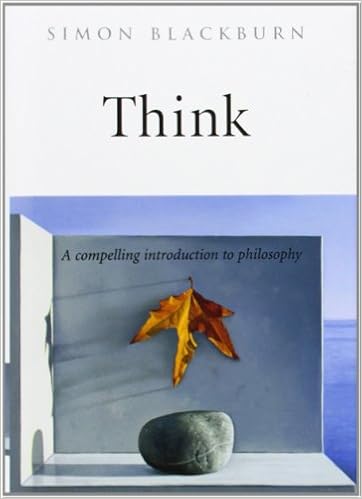


http://discover.halifaxpubliclibraries.ca/?q=title:think%20author:blackburnThe first book on the list is Simon Blackburn's Think: A compelling introduction to philosophy. Simon Blackburn wrote the Oxford Dictionary of Philosophy, but don't let that intimidate you. This book was written as a primer for anyone wanting to learn more about philosophy. In each chapter, the author discusses a major philosophical idea such as free will, and brings up different arguments, while using quotes and examples from famous philosophers. 


syndetics-lcThe second book is ideal for people who tend to prefer fiction over non-fiction: Sophie's World by Jostein Gaarder. This bestselling novel begins when a teenager comes home and finds some mysterious notes in her mailbox. This sets off Sophie's journey through the history of Western philosophy. The book is entertaining as a philosophical mystery, but the story serves to to sketch the outlines of the basic philosophical arguments that have appeared through throughout time. Perfect for a questioning beginner of any age!


My third recommendation is syndetics-lcThe Deepest Human Life: An introduction to philosophy for everyone by Scott Samuelson. Recently awarded the 2015 Hiett Prize in the Humanities, Samuelson is also known for his pro-humanities essay  called Why I Teach Plato to Plumbers, written for the Atlantic in 2014. This engaging book was written, like Simon Blackburn's, to be an introduction to philosophy for anyone interested in the human condition. Divided into four parts, the Samuelson goes over classic philosophical problems and relates them to everyday life.


syndetics-lc  Last but not least is The Book of Dead Philosophers by Simon Critchley. Okay, this one won't be as useful as the others - it's not a discussion of basic philosophy but a list of how famous philosophers have died. Nonetheless, it's entertaining to skim through the pages of this tome. Critchley lists numerous philosophers and gives tidbits of each one before announcing how they met their untimely (or timely) ends. You may discover an interesting philosopher that you didn't come across in the other books. Happy reading (and philosophizing)!


Wednesday, June 29, 2011

5 Books I Want to Read this Summer - Zoey's Picks

My summer reading list is heavy with non-fiction: I'm trying to become more informed in two particular subject areas: Buddhism and anarchism. But my study habits aren't terribly disciplined and I've snuck in a few mindless indulgences, just for fun.

I'm currently reading two brand-spankin' new publications: Noah Levine's The Heart of the Revolution (2011) and Property is Theft!: a Pierre-Joseph Proudhon reader (2011), edited by Iain McKay. The Heart of the Revolution, Levine's latest book, is getting a lot of attention in Buddhist circles (search #theheartoftherevolution on Twitter) and even has its own discussion page on the Tricycle website.

Although both authors draw on ideas and practices that have been around a while (the Buddha lived 2500 years ago, Proudhon died in 1865), Levine and McKay ably demonstrate the vitality and relevance of these figures in our own time period.

After having been recently introduced to the genre of Scandinavian crime fiction, I've discovered Yrsa Sigurðardóttir's Thóra Gudmundsdóttir series. The second in this series, My Soul to Take (2009), is now beckoning to me from my bedside table. Although this genre is completely new to me, I was attracted by descriptions of the main character, Gudmundsdóttir, whom Sigurðardóttir has conceived as a lawyer, investigator, and single mother.

For husband, I brought home a copy of Created in Darkness by Troubled Americans: the best of McSweeney's humor category (2005), edited by Dave Eggers [et al.]. He's been reading me the best bits (including, "Words That Would Make Nice Names for Babies, If It Weren't for Their Unsuitable Meanings": e.g., Feta, Calorie). I think I'll have to look through it myself before I return it to the library.

I thought I'd kicked my spy thriller habit after The Nearest Exit (2010), the second book in Olen Steinhauer's Mo Weaver trilogy (at least until number 3 comes out), and then I came across Otto Penzler's dramatically titled collection Agents of Treachery (2010). [Cue dramatic music] *DUN DUN DUN!* Steinhauer is included here (yea!), as are stories by Lee Child and Stella Rimington.


Now all I need is a deserted beach and a cocktail....

Saturday, March 19, 2011

Philosophical Fiction

I have been thinking a lot about philosophy lately, in part due to Eric’s recent blog post and a book that I just finished. Philosophy is a funny thing. There is no “right” answer to any question.

Even 1 +1 = 2 would have a philosopher questioning whether it was or not? You can drive yourself mad in the process and some philosophers, like Nietzsche, have. Well, since Eric focused on non-fiction books of philosophy I decided to give you a small taste of philosophy in fiction.

One of the most well-know fictional philosophy books is Sophie’s World by Jostein Gaarder. This novel on the history of philosophy is used as a text in some schools. Originally written in Norwegian, this unique novel has been translated into 53 languages and has sold over 30 million copies. It has also been adapted into a movie and a cd-rom game. Sophie, a 14 year old girl , receives a series of mysterious letters and postcards. Starting with the two messages “Who are you?” and “Where does the world come from?” ; the book moves through the history of philosophy starting with pre-Socrates on to Jean-Paul Sartre. It is a very fantatastical and (based on the sales numbers) readable story. Take a trip into Sophie’s world and see what discoveries you will make!

I just finished reading The Executor by Jesse Kellerman and it is the real reason that I wanted to write this blog. Kellerman (the son of Jonathan and Faye Kellerman) deserves to reach a wide audience. The fact he studied psychology at Harvard shows. Besides featuring a philosophy student, he delves into the psychology of the philosophers themselves, especially Frederick Nietzsche. The theme of free will and does it even exist flows throughout the novel. Joseph Geist is a man of high ideals but very little practical sense. He basically only own the clothes on his back and a half bust of Nietzsche. When his life is disrupted by getting kicked out of Harvard and his girlfriends apartment he is at a loss of what to do. An personal ad for a conversationalist changes his life...and his future! I love books that I can’t figure out how they are going to ends and this was one of them!

Continuing on the theme of Nietzsche, consider the debut novel When Nietzsche Wept by Irvin D Yalom. (a psychologist in his professional life). On January 3, 1889 Frederick Nietzsche experienced a mental collapse when witnessing the whipping of a horse. Joseph Brewer is a mentor of Sigmund Freud. He is asked by a friend of Nietzsche to help him. Nietzsche was a proud man and in order to help him Brewer pretends to be a mental patient himself. The series of conversations between the two men are thought provoking.

There are many other books that I could recommend on this subject but I promised a small taste of them so here they are. I hope that they are as thought provoking to you as they were to me.

Sunday, March 13, 2011

Intro to Psychology

When it comes to amateur psychology, I’m of two minds...ahem...

There is merit to reading the works of influential figures. They became key through their society-shaping treatises, which in turn become timeless. However, the original language may be too far removed from the modern reader to convey the more complex ideas. It is often useful to have an annotated copy.

For example, you could read Freud’s Civilization and its Discontents to get a grasp on psychoanalysis. You could read Jung’s Man and His Symbols to understand the archetypes within the human mind. You could read all of their works. And if you’re like me, you won’t understand any of them.

So try the How to Read series: Freud by Josh Cohen, and Jung by David Tacey. These guides are not condensed versions, biographies, or overviews. The How to Read series combines core excerpts from the original texts with professional analyses.

There is also merit in reading a broad overview. One can pick and choose elements of a field or pour through an entire textbook. Take the ironically named Complete Idiot’s Guide to Psychology by Joni E. Johnston, Psy.D., or The Everything Psychology Book by Kendra Cherry.

Both books are well-organized and structured for speed reading, full of facts and factoids. Yet these two are very different in their scope. The Idiot’s guide offers chapters based on commonly-known topics; the nature versus nurture debate, consciousness, behavior and profiling, abnormal psychology, control issues and disorders, intimacy, society, and medication, just to name a few.

The Everything Guide, which is written at much the same level as the Idiot’s, is presented with more academic flair. Topics include the types of psychology (cognitive, biological, etc), methodology, neurologic and genetic issues, altered mental states (sleep, drugs, hypnosis, etc), logic, learning and memory, language acquisition, and interpersonal behavior.

Here’s a title half way between the two: 50 Great Myths of Popular Psychology: shattering widespread misconceptions about human behaviour, by Scott Lilienfeld, et al. This book opens with a curious history of failed psychology, and how our ‘understanding’ changes to suit the ‘facts’…such as they are. (This is one of the rare books to discuss Phrenology! A real head-scratcher…) Short, but well-researched essays prove 50 beliefs false, using the most current findings. Classic fallacies tackled include how we use 10% of our brains, how opposites attract, how intelligence tests are unfair, and how polygraphs are accurate.

Got psych on the brain now? Considering a career? There are, apparently, tons of jobs available for psychology majors. Learn about schools, employment structures, career paths and future opportunities with either of these guides:

What Psychology Majors Could (and Should) Be Doing: an informal guide to research experience and professional skills by Paul Silvia, Peter Delaney, Stuart Marcovitch

Opportunities in Psychology Careers by Donald and Charles Super

Monday, March 7, 2011

The Universal Language of Mathematics - part two


... continued from yesterday's post.

"Nature's great book is written in mathematics." Galileo


Speaking of living math, there is a connection between numbers and spirituality.


Take a look through the tiny Sacred Geometry by Miranda Lundy, or the hefty How the World is Made: the story of creation according to sacred geometry, by John Michell and Allan Brown. Both titles look at the spiritual and philosophical nature of math, specifically geometric shapes. From the Platonic solids to Stonehenge, the Western Zodiac to the Golden Ratio, this is as much a book of numbers as it is a book of art.

"A mathematician is a blind man in a dark room looking for a black cat which isn't there." Charles R. Darwin

Perhaps a biography is of more interest.

There are biographies for mathematic fields, such as Unknown Quantity: a real and imaginary history of algebra by John Derbyshire. This is a dense book, which tries to map the erratic evolution of algebra; he claims “…the development of algebra was irregular and haphazard…”.

There are biographies for mathematic discoveries and problems, such as Poincare’s Prize: the hundred-year quest to solve one of math's greatest puzzles, by George G. Szpiro. This is the story of a math problem that remained unsolved for almost a century, and the unknown Russian who solved it…and rejected the prize and accolades.

And there are biographies of mathematicians themselves, such as the Canadian title King of Infinite Space: Donald Coxeter, the man who saved geometry by Siobhan Roberts. Coxeter revitalized modern geometry. He rejected algebraic analyses for a passionate eye for shapes. He loved polyhedrals, and surrounded himself physically with many-sided models; he was a direct inspiration for the graphic artist M.C. Escher, who is best known for his symmetry and his impossible structures.

For a biography, history and a math text all in one, try the impressive God Created the Integers: the mathematical breakthroughs that changed history by theoretical physicist Stephen Hawking. This guide examines 17 minds that influenced math the world over; names like Euclid and Archimedes, Descartes and Newton, Godel and Turing.

Perhaps the following is the best introduction to reading about math, since it holds various topics, and is written for a variety of readers and calculators.

The Edge of the Universe: celebrating ten years of math horizons, edited by Deanna Haunsperger and Stephen Kennedy, is a great choice for the hobbyist or professional mathlete. This is a compendium of the best articles from ten year span of the journal Math Horizons. Its short articles include biographies and histories, puzzles, curious math proofs, and interesting biographies.

Tuesday, February 8, 2011

"Plato and a Playtpus Walk into a Bar..." and other intros to Philosophy


An introduction to philosophy? “Why?” I hear you asking. How philosophical of you!

As near as I can tell there are two breeds of philosopher. There is the walking quote-book, brimming with facts and dates and names. If you describe a thought, they can name the theory. The other philosopher lives to think the next thought, typically ignoring its source and merit. If you describe a thought, they're unusually excited.

You must be asking why I am defining philosophers. My, you are so inquisitive!

If you prefer factoids to fantasies, you could perhaps start with Philosophy for Beginners, by Richard Osborne. With the use of comic book format, this book covers everything from the ancient Greeks to the Enlightenment, discussing the major voices of each period. The book continues with key philosophical theories and their advocates, including a chapter on North American thought.

If you need an introduction to philosophy in general, grab The Basics: philosophy by Nigel Warburton. A history and many theories are rewritten in simpler language, and classified under eight sweeping categories: An Introduction to Philosophical Thought, followed by God, Right and Wrong, Politics, The External World, Science, Mind, and Art. Once in the chapter of choice, applicable theories are briefly described, and accredited to their notorious thinkers.

Now we cross out of studies of thought and into the practice of thinking.

Try 50 Philosophy Ideas You Really Need to Know, by Ben Dupre. With a running timeline at the bottom of the page (which marks a theory’s place in history), nine categories frame the 50 queries detailed in this book. Plato’s Cave analogy, the Turing Test, the Ship of Theseus, and the Golden Rule are just some of the mind-blowing theories presented.

Perhaps you find philosophy painful to read. Check out, from Thomas Cathcart and Daniel Klein, Plato and a Platypus Walk into a Bar: understanding philosophy through jokes. Philosophy often breaks with practical thought, to the point that a theory might be ridiculous. Hilariously ridiculous, if you read this book! Illuminating jokes are paired with brief explanations, to make an easy read from such a dense topic. And curiously, it is the comedy that really helps define topics as like logic, perception, and free will.

Would you rather a book that helps you think, rather than make you think? Take at look at The Pig that Wants to Be Eaten: and 99 other thought experiments by Julian Baggni. Each question is phrased in a short narrative, followed by references, a discussion on why the question is complex, and suggestions for similar thoughts within the book. The chapters are short, good for perusing, while the notions are difficult, good for musing.

This is a book made to start (or stop) conversations.

And for a title that walks you through thoughts, thinking, and thinking about thoughts, grab something by Christopher Phillips, such as Six Questions of Socrates: a modern-day journey of discovery through world philosophy. Phillips is a modern philosopher with a love of Socrates and his method of inquiry. Dubbed ‘Socrates Cafes’, he hosts gatherings of average people, presents them with a deep topic, and lets them talk. He uses the Socratic Method, which is asking questions that verify, clarify, or nullify. The point isn’t to reach a conclusion, but to talk and think with one’s community. He speaks with people from all walks of life; reservation Natives, Greek academics, a classroom full of Japanese children, American maximum security prisoners, and Roman Catholics. Anyone curious about philosophy.

And if that includes you, why not start a Socrates Cafe of your own?